


Automated concreting reports: how SSK delivers Qlik reports to stakeholders and customers
SSK went live with Qlik Sense and ppmc.bmi.insights in under 14 days and uses Mail & Deploy to send reports to stakeholders and to site managers at customers' construction sites.
Building materials · Austria
Customer Success powered by our reseller partner PPMC
Before and after
Before
- Global warming potential (GWP) was calculated in Excel, with recipe data entered manually for each calculation.
- These calculations were time-consuming and error-prone.
- Data needed to check mixes, processes and recipes was spread across several source systems.
After
- Weekly concreting reports go automatically by email to the site managers at customers' construction sites.
- When a customer calls, SSK can immediately say whether the concrete met quality requirements and which quantities were delivered from which plant.
- Processes such as reporting accidents to the HR department are automated.
How it is set up
- Data sources
- Qlik Sense with ppmc.bmi.insights, connected to the scheduling program dorner.optimize, two laboratory information systems, a fleet management system, fuel billing software and vehicles' on-board computers
- Recipients
- Stakeholders, site managers at customers' construction sites; customers for GWP reports (possible)
- Delivery
- Email, FTP, Mail & Deploy Hub
- Split by
- GWP reports can show the emissions of a specific customer, construction site or company
- Schedule
- Weekly (concreting reports); GWP reports can be sent monthly, for example
For example, we can use the extension to send weekly concreting reports by email to the site managers at our customers' construction sites.
DI Bernhard Prem, Responsible for technology, Salzburger Sand- und Kieswerke GmbH
The problem
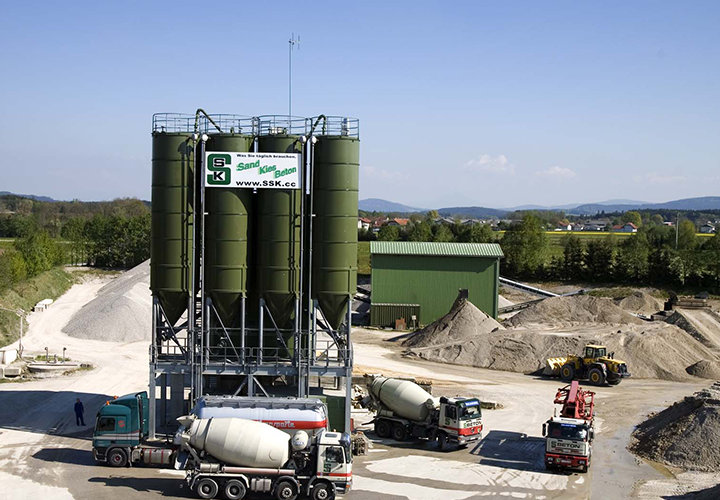
Salzburger Sand- & Kieswerke, founded in 1971 with around 550 employees, supplies concrete, sand, gravel, chippings and humus in Salzburg, Upper Austria and Bavaria. SSK wanted to see more quickly whether the ratio of aggregate, cement, water, additives and superplasticizers met its quality requirements, or whether recipes needed optimizing. That meant evaluating data from different source systems. GWP calculations were done in Excel, which was time-consuming and error-prone because recipe data had to be entered manually each time.
Why Mail & Deploy
- It sends reports to stakeholders on a regular, automated basis.
- Reports can be distributed through several channels: email, FTP or the Mail & Deploy Hub.
- SSK uses it to send weekly concreting reports to site managers at customers' construction sites.
- The GWP app developed by SSK and ppmc can use it to send emissions reports to customers, for example monthly.
What changed
- SSK has transparency across all areas of the company.
- Decision-relevant data is quickly available for management and operational employees, for example for optimizing recipes or negotiating prices with suppliers.
- Report generation and distribution are automated.
- Data quality has improved, because Qlik Sense helps uncover inconsistencies.
More customer stories
Smart Last Mile: how Berlin Recycling enables user-friendly customer reporting
Berlin Recycling
Roth Energie: data-driven management and automated reporting in volatile energy markets
Roth Energie
Book a Mail & Deploy workshop
Build your reporting skills with guided, hands-on training. Work through connecting data sources, creating reports and setting up distribution with a Mail & Deploy consultant.
Workshops cover both client-managed and SaaS versions of Mail & Deploy. Choose the session format that fits your team.